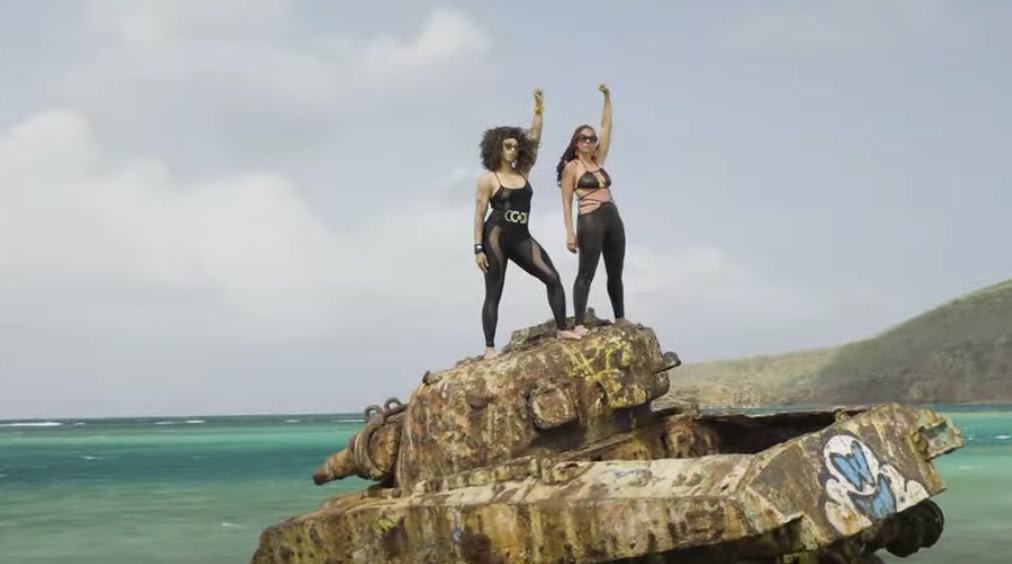
Steffanie Christi’an’s soulful rock avatar has been a powerful infusion in so many creative spaces around Detroit. The Kresge fellow has spent the past decade as the voice of Kevin Saunderson’s legendary techno outfit Inner City, the frontwoman for Don Was’s Pan-Detroit Ensemble, and one-half of We Are Scorpio with the city’s poet laureate jessica Care moore. Behind those expressions an individual voice still lives and is emerging with a heart of punk that guides each note of Christi’an’s musical trek.
“She’s In The Hospital” is a song by an obscure New York City rock band called DADDY that Christi’an saw perform decades ago. Her version is a blistering reclamation of that underground energy and an uncompromising introduction to her evolving solo vision.
Resurrecting DADDY & The Heidelberg Aesthetic
What is it about “She’s In The Hospital” that made you never forget and ultimately want to cover it?
When I first saw the band Daddy their aesthetic had something to do with it as well as how wild they performed. And I just thought the lyrics also were just very very raw and it just wasn’t like any song I had ever heard before.
What did their original sound like because clearly they broke up?
Yes and it was only released on a CD they never had it on streaming or anything so you probably would have to have one of those CDs to hear it. It did not sound very far off from the version we have. Lauryl does a lot of crazy phrases in the middle during the bridge like the outro is a little bit longer but essentially I tried to maintain the integrity of the song. I just felt like the section where Lauryl like did her little crazy talk—like people really thought she was having a nervous breakdown—it did not sound as authentic when I did it so I just didn’t do it.
Sounds like it was real raw punk.
Um hum.
Mayaeni directed the music video. Was that Tyree Guyton’s house?
Yes it was.
How did you guys come up with the concept?
We didn’t want to be so tongue in cheek that we actually filmed in a hospital. I wasn’t sure how we would be able to do that anyway especially with our budget of zero dollars. So we were just trying to figure out ways we could make it look kooky and I think it was Mayaeni who suggested that we go to the Heidelberg Project and once I got there I thought it was perfect. And I did have a friend who let us use her medical office to shoot the rest of it in. It wasn’t a hospital but we were trying to get that doctor’s office look.
What were you trying to convey with your version?
I don’t know exactly. I’ve just always been a big fan of the song. I can’t remember exactly when Daddy broke up but we kept in touch because after I moved back to Detroit I think like 10 years later I mean I was still listening to the song and I asked them. I sent an email: Would you guys mind if I covered it? They were like, Sure, no problem. And then I still didn’t end up recording it until 10 years later. And I wanted people to be able to hear that song. And I wanted to do it justice so I’m not sure if there was necessarily anything I was trying to convey. I just wanted people to hear how good my friends were.
Ancestral Roots & Healing Through Performance
Who or what are your muses?
Definitely my ancestors. And there are several female singers that I look to for inspiration and that’s Tina Turner, Betty Davis, Billie Holiday, Janis Joplin. And it’s not just women—I love Bob Marley so very much and even though my music is not reggae I just look to him for inspiration. He was an amazing musician, he was an amazing songwriter. But I definitely try to go an ancestral place. My love of music comes from my grandfather and my grandmother who have passed many many years ago, but I don’t think I would be who I am without them.
Were they musicians as well?
My grandfather could play the guitar and he sang. My grandmother just really really loved Mahalia Jackson.
And you remember that growing up in the house?
Yes, my grandfather taught me how to play the guitar as well. We made up songs about everything. We would sing the blues and just make up any kind of goofy lyrics. He made up songs about how to learn—he would teach us stop lights: Red means stop, green means go, yellow means slow down fella. Just like songs to teach us and help us learn.
You co-produced your own vocals on this track alongside Nadir Omowale. When you produce your own voice, what are you listening for in terms of phrasing, dynamics, and letting that raw, visceral edge cut through?
Well particularly for this song because Lauryl’s vocals were so—I mean Lauryl was a different kind of singer, very very enigmatic. I mean just nobody could sound the way she did once she sang. Her voice was like poetry and she had this very weird way the way she sang that song she did sound like she was a crazy person. Me and Nadir went through all different types of ways we wanted to record that vocal. He wanted me to sound like I was crazy: Can you make your voice sound a little bit deeper, a little bit more unhinged? And to me that wasn’t necessarily the best way to go about it. I’m not saying we didn’t do it right, I’m just saying that trying to imitate Lauryl wasn’t the best way to go. So I had to figure out a way that I still maintain the integrity of the song and the emotion of it while still being myself.
In your Kresge Arts Fellow profile, you spoke about ancestral veneration and described the creative work you do as being of a “healing kind.” When you’re performing such heavy, emotionally charged material, how does that become a healing ritual for both you and the listener?
There is no me without the audience. To me it’s a shared experience and as much as I want to give the audience in regards to my performance, I also need back from them and their energy as well. It’s really really hard to perform to people who aren’t paying you any attention, but I find that it’s a shared experience. People come up to me and tell me that they’ve never experienced anything like that, they’ve never seen anyone perform like me before, and I find that to be so rewarding.
How is it healing for you?
Being able to express the way that I do when I sing and when I perform. I wouldn’t necessarily say that I’m an introvert, but I’m very guarded. But when I sing or when I perform it totally goes out the window and I can embody every emotion. Sometimes I feel like a giant, sometimes I have to feel very insecure to get this one song across, I have to feel a certain amount of sadness. And those things can be healing for me because I’m able to express myself the way that I need to in order to get those emotions out.
Rocking Global Stages: From Inner City to Willie Nelson
You front Don Was’s Pan-Detroit Ensemble, command dance floors globally as the voice of Inner City, and tear down rock stages with We Are Scorpio. What is the internal thread inside of you that connects all of these expressions so seamlessly?
I guess that I would say that I have a love for performing, I have a love for singing. So while I consider myself to be a rock artist to me it doesn’t really matter as long as I am able to do the work. And in some sense even if I’m performing electronic music with Inner City or I’m doing jazz fusion with Don Was—me and Jessica are totally punk so that’s who I am—but I still embody all of those elements when I’m performing. To me I still feel like a rock singer, I still feel like a rocker performer when I’m doing electronic music or doing jazz.
So you just claimed the rock singer place, but out of those three things is one more fun than the other or do they serve different purposes?
They all serve different purposes. They all feel great in different ways. Performing with Inner City usually we’re overseas and it’s really big festivals—you could be performing in front of 50,000 people. And just like the energy is just outstanding. And then Don Was you know we were performing for the 50th anniversary for Blues for Allah by the Grateful Dead. We performed the whole album for the past year and the Deadheads are such great fans. I mean there will be people in the audience dancing and crying and you can tell that that music really really touched them. And performing in front of them is awesome as well. Like I said it all serves a different purpose.
Is that also linked in with Willie Nelson’s 2026 Outlaw Music Festival—is that with Don Was as well?
Yes, that was with Don.
What was that like?
It was amazing. We went on pretty early—I think we were the second act—which was absolutely fine with me because we had the rest of the day to sometimes watch other bands which was amazing. Usually we were just getting on the bus to get to the next venue because they were not close together. But being able to watch Willie Nelson was such a trigger to me. My grandfather is probably turning over in his grave right now knowing I got to sing on the same stage as Willie Nelson—he loved Willie Nelson. Our set is usually somewhere around two hours and we were only performing for 40 minutes so that felt really different. I’m not sure if the rest of the band felt this way, but I definitely felt like we had a shorter amount of time to prove who we were and make new fans.
An abbreviated experience.
Um-hum.
The Current Playlist & Local Detroit Innovators
With that being said, what are you listening to right now?
You know I hate to admit that I am a person that is kind of stuck on music that I listened to when I was younger, but this person wasn’t out when I was younger: I listen to a lot of Reignwolf, I listen to a lot of Chevelle, I listen to Royal Blood. This band called The Tiny. And Jeff Buckley. That’s what I’ve been rotating lately.
I didn’t know any of those people except Jeff Buckley.
Yes, they’re all a little kooky in their own way.
So now I have stuff I have to go look up.
And they’re all very different.
What about local folks since you’re like a local legend?
Well, always Nadir Omowale. Monica Blaire. And Jessica—Jessica just released a new techno album that’s really dope.
“It’s a bunch of Black women making rock music, and I don’t think it’s necessarily been the easiest thing to do. But I have been able to develop wonderful fans and just really feel appreciated for being Black and making the music that I love.”
— Steffanie Christi’an
The Industry, Black Women Rock, and The Solo Horizon
With “She’s In The Hospital” out in the world today, what is on the immediate horizon—are we building toward an EP, a full-length record, or upcoming Detroit live dates?
You know I don’t know. Singing in all these bands takes up all of my time. I’m trying to devote time to my own projects but it’s just really really difficult at the moment. But I already have another single that’s ready and recorded to release, mixed and mastered. I’m just not ready to share it yet. I don’t know if I’m working towards an EP or not—that was the plan, actually a whole LP was the plan. But I look back and I said I was going to do that in 2024 and it’s almost 2027. Time is getting away from me a little bit like that, but it’s not like I’m not doing anything. I can not tell you how many singles I have recorded with Inner City. Two albums with Don Was already.
How did you start singing and what did a singing career look like for you? Did you ever have a major solo vision?
Absolutely, I’ve been singing professionally since I was probably eight or nine. I started singing in this girl group called The Honeys. It was very short-lived but I started there. As soon as my mom realized I could sing she put me in church. I was in another little girl group. We took it seriously—I mean we were like kids but we all knew that we wanted to sing.
Once I got a little bit older I started writing my own music and teaching myself how to really really play the guitar. I got a manager and I was introduced to somebody at Famous Music Publishing and they were flying me out to New York maybe once a month—like definitely every school break. I would be in New York working with different songwriters. I wanted to be Beyonce and Rihanna before there was a Beyonce and Rihanna. I wanted to be a pop star. I wanted to be a Michael Jackson. I wanted to be a huge star.
And then the older I got and then realized it wasn’t so easy to be Black and make rock music. I mean it’s easy to make it. It’s harder for people to pay attention to you. Or to take you seriously—I mean I don’t know, I don’t know why things are the way that they are. But I had to reevaluate what success meant to me. You know once I started singing backup for different groups and being able to get out on the road I was like, Maybe I can do this full time but not be a solo artist. Not that I never wanted to not be a solo artist, it’s just sometimes you gotta pay the bills.
I also really do—I’m really grateful for those times I was singing with other people. I’ve been in several bands I was the lead singer but it wasn’t necessarily my band. Those experiences, I couldn’t pay money for those experiences. They were amazing and I am the type of performer, type of singer, and songwriter that I am today because I had those experiences.
Speaking of that powerful lineage with Jessica and Black Women Rock, how has sharing those stages with other visionary Black women shaped your own unapologetic presence as a solo artist?
You know I was just thinking that when I got done with that experience I was like, Black Women Rock! too. Black Women Rock allows you to be on a platform you wouldn’t normally have. Our goal has always been to make it bigger, have bigger artists, be on bigger stages. And again it’s a bunch of Black women making rock music and I don’t think it’s necessarily been the easiest thing for Jessica to do and for any of us to do. But I have been able to develop wonderful fans and just really feel appreciated for being Black and making the music that I love.
What’s next?
I think I will probably release my next single after the new year. I think that will give me enough time to really promote “She’s In The Hospital” the way that I want to. Nobody is really paying attention to stuff during this time of year—everybody’s on vacation. I’m going to give it until the new year to release my next single. Just try to figure out what I’m doing.
I’m looking for a booking agent which I’ve never had before. I have a lot of recognition with different groups—everybody knows that I front Inner City, everybody knows that I front Don Was, everybody knows that I’m in this group with Jessica. But I have not been able to create an infrastructure that revolves around my solo career in the same way, and that’s what I’m trying to do.
I gladly welcome a solo album and I know whoever you collaborate with would be interesting. Do you play anything else besides the guitar?
I don’t really play the guitar anymore, and I’m just not like a pro anymore. I started learning how to play the bass which I really enjoyed more than the guitar. I have like a hand injury so it makes it difficult for me to play for long periods of time certain chords on the guitar because I can’t control my ring finger and my pinky finger. So it’s a lot easier for me to play bass with my hand. I was practicing quite a bit a couple of years ago and then I was using someone else’s bass and they had to take it back and I just never bought another one because I had a lot of shit going on.
Speaking of that solo dream album, any dream collaborations you want to do before it’s all said and done?
I really really want to work with Jack White.
That would be awesome. Anybody else? Any rappers?
I’ve sang with Talib and done shows with him. I’ve done tracks with him as well. When Proof was alive I used to do stuff with him—I used to record hooks for him. My other collaboration would be Tori Amos.